In Asia, there’s an ongoing irony that deepens as the natural world dwindles to the size of a parking lot. Wild animals, once revered and assigned all kinds of spiritual meaning, are increasingly ending up as the main entrée or as decorations for the rich.
The tiger, for instance, that fierce and terror-inducing king of the jungle, is no longer feared so much as coveted: as a rug, as jewelry made of fangs, as a quixotic dish, or as medicinal products made from its various parts – bones and penis and gall bladder – thought to improve man’s sexual prowess.
But nowhere is the irony as deep as it is in Thailand, where the regal Asian elephant is now facing extinction. According to a recent story reported by the Bangkok Post, three men were arrested this week in Ayutthaya for poisoning an old bull and sawing off its tusks. Arrested, it was also found that they had previously served time for poisoning four tigers in a zoo and took one tiger’s carcass to sell in 2010.
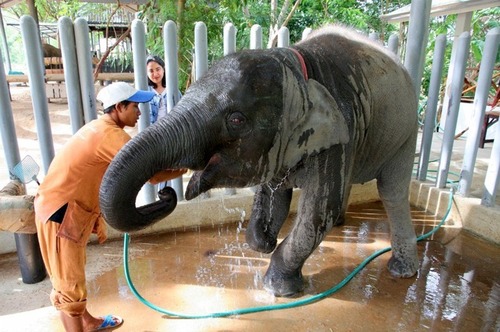
World’s First Elephant Hospital in Thailand
So here’s the irony: The Asian elephant is still a revered cultural icon in Thailand, gracing bas-reliefs of temples and ancient paintings of battle scenes, but it is fast disappearing in reality. The country whose civilization was more or less built on the elephant’s back is now turning its back on the animal.
Indeed, the elephant once served as both builder and war machine: carrying logs and rocks and uprooting trees to build palaces and temples, while fighting countless wars bedecked in the armor of a warrior.
Within Buddhism, Thailand’s state religion and a binding force across much of the region, the elephant remains sacred. According to legend, a white Elephant appeared in the dream of Queen Maya, holding a white lotus flower in its trunk. She later gave birth to the historical Gautama Buddha, Siddhārtha.
Alas, sacred is quickly cast off for cold hard cash. An elephant penis can now fetch as high as $1,000 and a pair of tusks as high as $63,000. Though illegal, poaching has now reached what environmentalists are calling a “crisis point.”
At the beginning of last century there were more than 100,000 wild elephants in existence. One hundred years later the population has dwindled to less than 4,000 domesticated elephants and 3,000 in the wild in Thailand, according to the National Parks, Wildlife and Plant Conservation Department.
Classified as an endangered species, the Asian elephant is expected to disappear from the wild altogether around 2050, if not sooner.
But while poaching is particularly abhorrent, there are other reasons behind the elephant’s disappearance, chief among them deforestation.
For domesticated elephants in Thailand, deforestation means no more jobs. Logging in Thailand’s forests has long relied on the strength of the powerful pachyderms. An elephant can pull half its weight and carry 600 kilos on its back. In hilly countryside where roads are small and inaccessible to trucks, an elephant is indispensable for the timber business. But logging is all but illegal now in Thailand, and the domesticated elephant, it seems, is so efficient at the timber business that its habitat no longer exists, and it is out of luck.
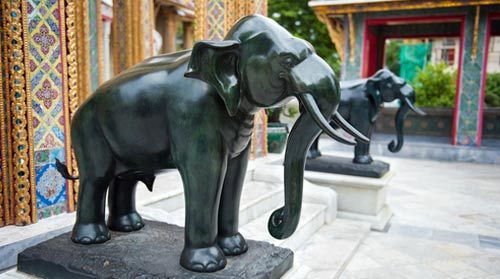
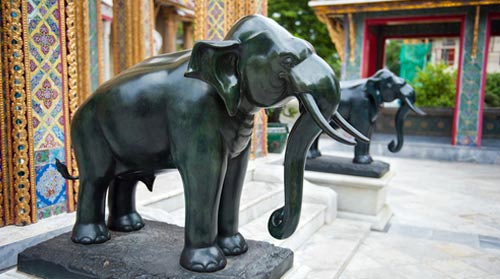
Elephants guarding a Wat Prakeo in Bangkok
An average Asian elephant weighs 11,000 pounds, and consumes more than 26 gallons of water and 440 pounds of food a day. That’s why their owners consciously curb breeding among the captive beasts, bringing down their number even farther.
Many owners, left with no other choice, have now turned their elephants into urban beggars. It’s not a rare sight to see elephants begging in various urban areas of Thailand.
For the wild elephant conditions are even worse.
Only about 15 percent of the country is still forestland, and those patches are widely scattered. Many wild elephants resort to raiding farms for crops, where they are often shot or poisoned by subsistence farmers.
According to a an Associated Press article in 2012, a new taste for elephant meat has sprung up in mega-modern Thailand as well. The once revered elephant is now being served up alongside the tiger: on a fanciful diner’s plate. Elephant sashimi, apparently, has become the quixotic taste for the nouveaux riches.
Man has conquered everything but himself. The wild is now what we call a reserve, the wilderness nowhere but within. But in a world where even the sacred is devoured, one can’t help but wonder, in another century or so, whether there will anything left but a horde hungry humans, and those that will inherit the earth, cockroaches?
Andrew Lam is an editor with New America Media and author of the “Perfume Dreams: Reflections on the Vietnamese Diaspora,” and “East Eats West: Writing in Two Hemispheres.” His latest book is “Birds of Paradise Lost,” a short story collection, was published in 2013 and won a Pen/Josephine Miles Literary Award in 2014 and a finalist for the California Book Award and shortlisted for the William Saroyan International Prize for Writing.