No Image

Consuming Country — Food on the 4th of July

July 7, 2014 0

We’ve heard often enough that we are what we eat. But it is equally clear that we also eat what we are. Food connects us with others who eat like us. Take the 4th of July. We recreate our country by celebrating together, and celebration entails eating …

No Image

Chillin’ With Chilean Wines

July 7, 2014 0

While Brazil is garnering attention these days from soccer fans worldwide, Chile is quickly building a fan base of its own. Long recognized for the quality of its seafood and agricultural products, The International Organization of Vine and Wine believ…

No Image

Why You’ll Have What She’s Having — Even When You Really Want Something Else

July 7, 2014 0

By Rachael Rettner, Senior Writer
Published: 07/07/2014 10:49 AM EDT on LiveScience

Have you ever been at a restaurant table where everyone ordered a salad? A new finding may explain why this happens: When we order in groups, we like to be similar to our friends, even if it means ordering something we would not typically pick on our own.

Researchers analyzed receipts from 1,459 people who ate in groups at an Oklahoma restaurant over a 19-week period. There were 51 items on the menu to choose from, which fit into eight food categories (soups/salads, burgers/sandwiches, combo meals, pasta, vegetarian dishes, choice steaks, prime steaks, and the daily specials). Some tables were given menus with calorie information on them, while others were given menus without calorie information.

Diners at the same table tended to pick main dishes that were not exactly the same, but were from the same category — for example, if one diner ordered a mushroom burger, another might have ordered a bleu cheese burger. [9 Snack Foods: Healthy or Not?]

“We want to be different from our friends a little bit, but not too different,” said study researcher Brenna Ellison, an assistant professor at the University of Illinois at Urbana-Champaign’s Department of Agricultural and Consumer Economics.

Friends may play a role in what we order in part because humans have a natural tendency to want to fit into groups, Ellison said. Also, because there were so many choices on the menu, people may listen to what their friends are ordering so they don’t need to look at everything on the menu, Ellison said.

The researchers also estimated how much each menu item was generally liked, by looking at whether people tended to choose certain items over others. Factors such as an item’s cost and calories can affect how much an item is liked, she said.

In general, people didn’t really like salads or vegetarian dishes, compared with the other food choices. But in the study, that changed if more than one person at a table ordered a salad: the more salads that were ordered, the more people liked them.

The same was true for high-calorie and expensive dishes — these dishes were not typically liked unless more than one person at a table ordered them. “People are happier spending money and eating more calories as long as their peers are,” Ellison wrote in a paper that will be published in the October issue of the journal Food Quality and Preference.

Although there has been a push to put calorie information on food menus, and to make healthy dishes less expensive, the new findings raise questions about how effective these efforts will be in getting people to eat healthier.

“Our results suggest that a lot of the choices we make seem to be dependent on what the people we’re eating with are doing,” Ellison said. So “should we nudge people toward healthier food, or healthier friends?” Ellison said.

While picking new friends may not be feasible, there are a few things people can do to eat healthier in groups. If you volunteer to order first, your healthy order may influence the rest of the group, Ellison said. People can also check out restaurant websites before going out, and suggest meeting at a restaurant with a greater number of healthy food choices, Ellison said.

Follow Rachael Rettner @RachaelRettner. Follow Live Science @livescience, Facebook & Google+. Original article on Live Science.

Copyright 2014 LiveScience, a TechMediaNetwork company. All rights reserved. This material may not be published, broadcast, rewritten or redistributed. ]]>

No Image

Apple Mint Sangria: A Kitchy Kitchen Recipe

July 7, 2014 0

I feel like mint gets a bad rap as a flavor, but it’s one of my favorites. It’s not just a garnish, or something intended for an ice cream cone; mint can be earthy, mint can be subtle, mint can be everything you thought it couldn’t, because the herb…

No Image

This Family Went To Enormous Lengths To Rid Themselves Of ‘Stuff’

July 7, 2014 0

Five years ago, Catherine and Temple Pond led a seemingly picturesque New England life in the small New Hampshire village of Hancock. Their Federal-style home, built in 1813, had been passed down through the Pond family for generations. But as the coll…

No Image

Millionaire Fast-Food CEO: Higher Minimum Wage Hurts Us All

July 7, 2014 0

One fast-food CEO has a message for the workers toiling away in his industry: The minimum wage hike you’ve been clamoring for will only hurt you.

The consequences of raising the minimum wage include more youth unemployment, higher prices and increased automation, says Andy Puzder, the head of CKE restaurants, the parent company of Hardees and Carl’s Jr.

“Government needs to get out of the way,” Puzder told Yahoo! Finance in an interview Monday. “If government gets out of the way, businesses will create jobs and wages will go up.”

So far, the federal government has largely stayed out of the way. Congress has not taken up President Barack Obama’s call to raise the minimum wage to $10.10 an hour from $7.25. And with the exception of a few companies, like Costco, In-N-Out Burger and Boloco, businesses haven’t taken the initiative to create higher paying jobs.

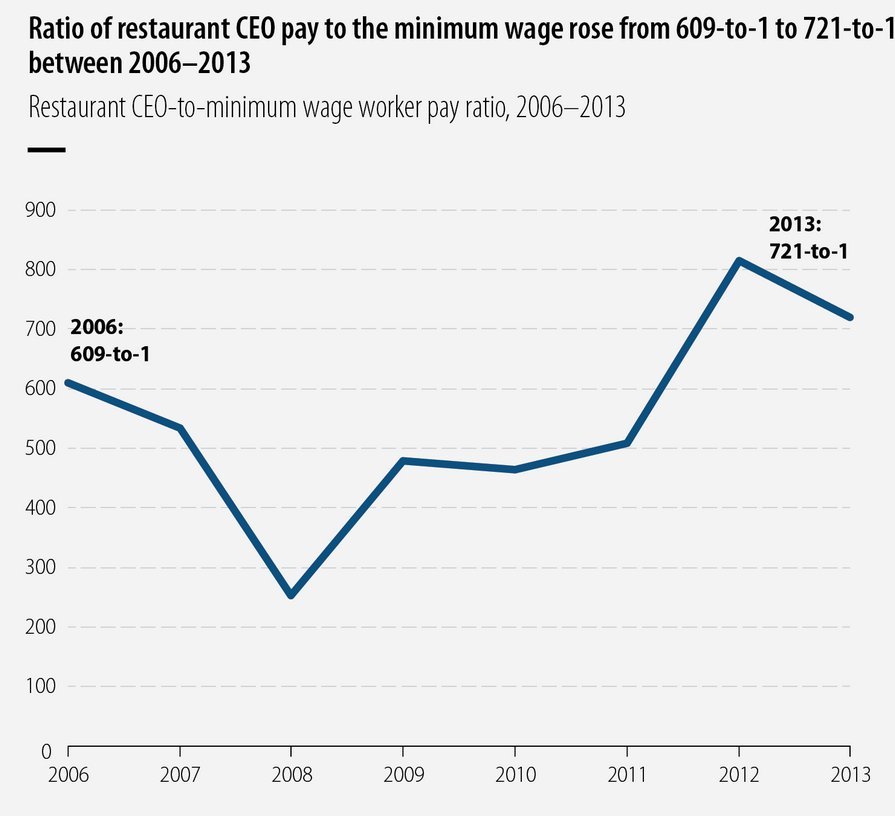
Puzder made $4.4 million in 2012, according to Forbes. That’s about 291 times what a minimum wage worker makes in a year, if they’re earning the federal minimum and working full-time. The average fast food CEO made 721 times what minimum wage workers took in in 2013, according to a recent report from the Economic Policy Institute.

chart

Puzder doesn’t address this imbalance. Instead he argues that raising the minimum wage would price teens and young adults out of a job because more experienced adults will want to flip burgers and make these higher wages. In states that have already raised the minimum that’s what’s happening, he said. More experienced workers are “willing” to take these higher paying fast food jobs, particularly after seeing their hours cut because of Obamacare.

There are two problems with Puzder’s reasoning: First, there’s little evidence that companies are cutting worker hours because of Obamacare.

Second, while it’s true that more adults are working in fast-food now, that’s largely because of an economic recovery that’s mostly taken place in low-wage work. Jobs that pay low-wages, like those in fast food, have accounted for 44 percent of job gains over the last four years, while middle-income jobs accounted for 26 percent of job gains during the same period, according to an April report from the National Employment Law Project.

In other words, adults are working in fast-food, because they have no other alternative. Not, as Puzder would claim, because of wages that are slightly higher than the federal minimum.

About 40 percent of fast food workers are at least 25 years-old and more than 30 percent have at least some college education, according to an August analysis of Census data from the Center for Economic and Policy Research, a left-leaning think tank focused on economic issues.

For his part, Puzder — who has railed in the past against policies that could hurt his bottom line, like expanding the types of workers eligible for overtime — said that “very few” of his employees, particularly the older ones, make the minimum wage.

CORRECTION: An earlier version of this post incorrectly stated that CKE is the parent company of Arby’s. Arby’s is owned by Roark Capital Group, which also owns CKE.