No Image

This New England Ice Cream Stand Is Proof That America’s Work Ethic Endures

July 7, 2014 0

“One day, Annalise and I were in the [scoop] shop and a customer came in and said, ‘There’s a calf running in the middle of the street!’ The two of us go running outside, I got that calf by the neck and Annalise comes up behind it… and it goes to the bathroom all over her. And then the calf swings, and it’s all over me. We had to shower and change. It was everywhere.”

Welcome to a typical day at Flayvors of Cook’s Farm, an ice cream shop in Hadley, MA. Take a few minutes talking to Debby Cook, the woman who runs the shop, and you’ll find there’s a lot more that goes on at this establishment than scooping ice cream. While your typical ice cream shop might be ubiquitous in New England — there are more of them than clover flowers in a summer field — Flayvors is nestled between 120 dairy cows and three old wooden barns on the property of Cook’s Farm, a three-generation dairy farm that’s a beloved gem in the community. But it took a lot of work to earn that reputation.

For most of us, an ice cream shop is a moment’s thought, a quick indulgence, a summer treat. But for the Cook family, it is their entire life. ”You know that saying, ‘[Man may work from sun to sun, but woman’s work is never done?] Well, it’s that way here, only it’s a farmer’s work,” says Beth Cook, who also works on the farm. “Because even on a rainy day you’ve got to fix the plow, so when the sun comes out, you can go plow. Or, you’ve got to help your wife make shelves in the store. The door knobs need mending, the locks are all jamming in, the picnic tables are breaking.”

The family operation all started with Pop — full name, Gordon Cook — who was born on Cook’s Farm. In fact, he was born in the same room he passed away in 10 years ago. “When pop was 90 we’d send him out to pick up things for the store. He’d just get in that little truck of his and just zoooooom,” Beth recounts. “I think that’s part of the reason he lived to 92,” Debby chimes in. “There’s always something to be done.”

“They say farmers don’t retire, they just get tired,” Beth adds.

Tired is an understatement. Debby ran down a list of the daily chores at the dairy farm, and just hearing her recount a day-to-day is exhausting. The morning starts with a check of the barns and cattle at 5 a.m. to ensure nothing’s amiss. Milking starts at 6 a.m. — 10 cows at a time if all goes well, and there are 120 cattle to attend to. Once the milking’s done, the barns need cleaning. There are three barns and they are not small. Then, the cows need feeding. If one of them isn’t well, they’re taken care of (the Gordons are also trained to provide the cattle with healthcare). At 3 p.m., it all begins again: Milking, cleaning and feeding. And that’s not even touching upon the fields that need plowing or the fences that need mending, or anything that goes into producing the goods of the ice cream shop.

The daily chores are grueling and messy; not just anyone can do it. Not even some of the people living on the farm itself. Beth married into the farm back in 1974 and never imagined herself milking cattle. But that’s exactly what she did for 15 years, until she was able to escape to the scoop shop. She responded to the labors of barn work the way many of us would, saying to herself, “‘I know that god didn’t put me here to do this.’ I’d have cow poop all over my face and I’d say, ‘I know I wasn’t supposed to do this. He didn’t tell me I was supposed to do this.” Clearly, working a dairy farm is not all fresh milk and ice cream cones.

cooks farm

In 1998, mother and daughter-in-law Beth and Debby opened Flayvors of Cooks Farm, the scoop shop, which not only makes a mean cookies-and-cream flavor, but that also sells raw milk straight from the dairy, if you’re smart enough to ask for it. (According to Massachusetts law, raw milk has to be kept behind the counter so that no accidental purchases are made.) The shop was started not only because both women always dreamed of having an ice cream stand on the farm — they each spent summers scooping in their teenage years — but as a way to accommodate the expenses of the growing family. When the shop opened its doors, Debby had her first child in a playpen behind the counter. When her second child took that spot, the first took post at the cash register ringing up people’s orders as she was learning to speak. When you live on a farm, you work on a farm, no matter what age you are.

The first years of any business require total devotion, especially in the service industry. Multiply that by about 120 and you’ve got a better idea of what it takes to open a shop while running a farm and starting a young family. But fatigue and hard work aren’t a deterrent. One of Flayvors’ most popular ice cream flavors, Pistachio Mint, was an accident that resulted from total exhaustion in the early years. Through her groggy eyes, Debby thought the pistachio was mint, she added chocolate chips, and a favorite flavor was born. Another time they added Oreos to the ice cream machine too soon, and what resulted was a gray mess. A tasty mess, but gray ice cream nonetheless. Not letting that deter them, they turned it around and sold it as the Great Grey Mistake.

“And then people will have requests,” says Debby, a.k.a. the ice cream fairy. “I had several requests for Grape-Nuts ice cream, so ended up making a half batch for those people.”

While Debby is the muscle and brains behind Flayvors, Beth is certainly the soul and spirit. “I just do what I do, that’s who I am. We have asparagus ice cream. We’ve got a line of people here, so I get a plate and put a bunch of spoons on it and ask, ‘Do you want to try asparagus ice cream? No? Oh, you big chicken,’” Beth recounts, laughing. “That’s pretty much the tone you feel walking into Flayvors. It’s fun-loving and playful. And that’s part of the reason folks make the journey to the farm. That and the Cookies and Cream.”

Cook’s Farm isn’t just a dairy farm and ice cream stand, it’s also an option for the residents of the community to eat and support locally. And the family makes it a point to do the same, working not only locally but with family-run businesses like theirs. They’ve found that’s where the heart resides within the industry. “The biggest person that supplies us with our ice cream items is in Massachusetts. He’s the owner, the person who runs everything, and the person who takes our orders every week. One time he met me on Route 2 halfway from Boston at 9:30 at night, because we were out of ice cream cones. It was just unbelievable,” Debby recounts.

Similarly, standing on Cook’s Farm is like being transported back to the 1950s, when families came first and personal relationships meant something. But that return to simplicity is not without consequences. The farm is small time in this day of Big Ag — it certainly feels the competition — and business isn’t guaranteed. “The worst part for me is that the future is so uncertain,” confides Debby. “It’s different from other jobs, where you’re going to get a raise. The market is dictated by so many outside factors that no matter how well you do your job, it does not matter.

“You always have the risk that we could lose it all. And you just got to keep plugging away. You just keep your head down and keep going. Hank’s favorite quote is, ‘A long, hard day sure ain’t much fun, but you’ve got to get it started if you want to get it done.’ It’s that old Aaron Tippin song. He says it all the time. He’s like, ‘If you stop and think about it, you’re going to get so overwhelmed. Just put your head down.’

“And I think that’s probably the hardest thing. Certainly as a mom you know that’s really hard. You know, my daughter’s looking at colleges and I’ve already told her she’s not going. She needs to go to community college first because we can’t afford that.”

A farmer’s future is one encompassed with risk, but they’re willing to take the gamble for the rewards the farm life sows. Beth knows how lucky she is as a grandmother to be able to live on the same property as her five grandchildren. And then there are the folks who frequent Flayvors who she’s come to know and cherish. “When I look at how old those kids are, I remember when Mary [the eldest grandchild] would punch the register. People come up to me now and say, ‘This is my daughter,’ and I think, ‘What? You have a daughter? I remember when you were a little baby.’ It’s just amazing to be a part of the community like that.”

At the end of the day, a toddler holding a stuffed dog under one arm and a cup of ice cream in the other, walks by and timidly waves after Beth greets her in her boisterous, warm-hearted voice. “Hi, hi,” Beth chirps. “One for the stuffed dog and one for you.” “You see,” says Debby, “That’s the best part. When you have a two- or three-year-old that says, ‘This is the best ice cream I’ve ever had in my life.’ Really? It hasn’t been too long [that they’ve been alive], but I sure am glad we made the list.”

Here’s a look at Cook’s Farm, courtesy of Debby Cook who also happens to be a great photographer.
No Image

Wine In A Can Appeals To The Rebel In All Of Us

July 7, 2014 0

Wine is often thought to be the stuffier of alcoholic beverages: Beer is for the every man, spirits are for the parties. But wine comes served with thousands of years of tradition, all bottled up behind mystifying labels and poured into fine glasses. B…

No Image

12 Recipes That Sound Difficult But Are Surprisingly Easy

July 7, 2014 0

Cooking an impressive meal doesn’t have to be difficult. Sure you could take painstaking measures and spend days preparing a perfect Beef Wellington or Baked Alaska, but you can also get by doing a lot less.

Luckily, there are so many dishes out there that require very little work and experience but have a very rewarding payoff. Think risotto is out of your reach? How about chicken liver pâté or vichyssoise? Trust us — they’re easier than they sound.

Here are 12 recipes that sound difficult but are surprisingly easy to make. Let us know what your go-to easy but impressive meals are.

Want to read more from HuffPost Taste? Follow us on Twitter, Facebook, Pinterest and Tumblr.

No Image

A Look At New England’s Ice Cream Stands, From Maine To Connecticut

July 7, 2014 0

From the coastal towns of Maine to the farm land of Connecticut, ice cream stands are spread all across New England. They bring communities together and bring joy to everyone who visits. Whether they’re seasonal enterprises or open all year round, these ice cream stands hold a lasting presence in New Englanders’ consciousness. They represent all the joys of summer: warm weather after a long, harsh New England winter, gathering with friends and family, enjoying the outdoors, and kicking back and relaxing.

As many ice cream stands as New England boasts, no two are alike. Their unique locations, compositions and individual histories are an integral part of each one’s character — and it is this diversity that makes the New England landscape so special. One ice cream stand might be based on a family-run dairy farm, and one might be a seaside shack open just a few months a year.

To New Englanders, ice cream stands are commonplace; they’re expected parts of the scenery. When summer rolls around, it goes without saying that your family will take frequent — even daily — trips to get waffle cones, sundaes and frappes (also known as milkshakes outside of New England). Ice cream is like part of the New England DNA — along with resilience, independence and the Patriots, or course.

It’s been a long winter and summer is finally here, so go out and get yourself some ice cream in true New England spirit. July just happens to be National Ice Cream month, so it couldn’t be a more perfect time to hit the road and check out some of the best ice cream that New England has to offer. Here are eight ice cream stands that represent some of the special flavor that ice cream brings to New England.

Salvador’s Ice Cream (Massachusetts)
salvadors1
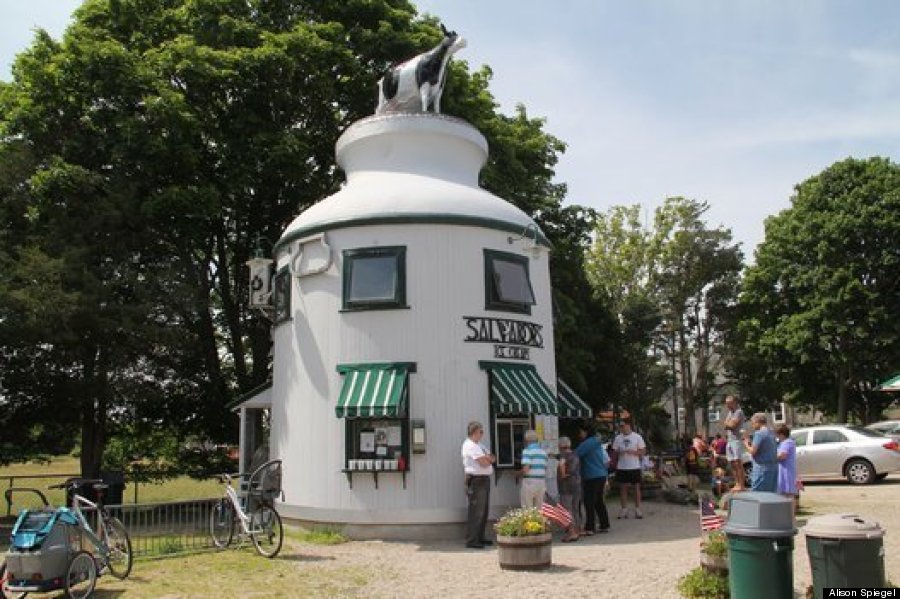
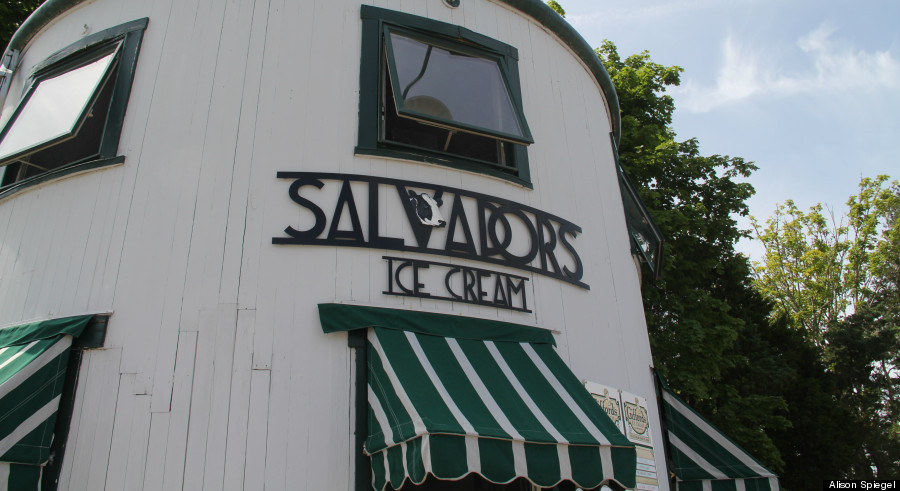
Salvador’s started as a dairy farm in 1890. The dairy building was originally located in New Bedford, MA, and in 1936 the milk jug was moved to Smith Neck road, a quiet residential street in Dartmouth, MA.

salvadors3
Ownership of Salvador’s has been passed on over the years, and the current owners, Len & Beth Gauvin, have received accolades from the New Bedford Historical Society for maintaining this historical structure. The cow on the top of the milk jug is named Smith Neck Nellie.

The Daily Scoop (Rhode Island)
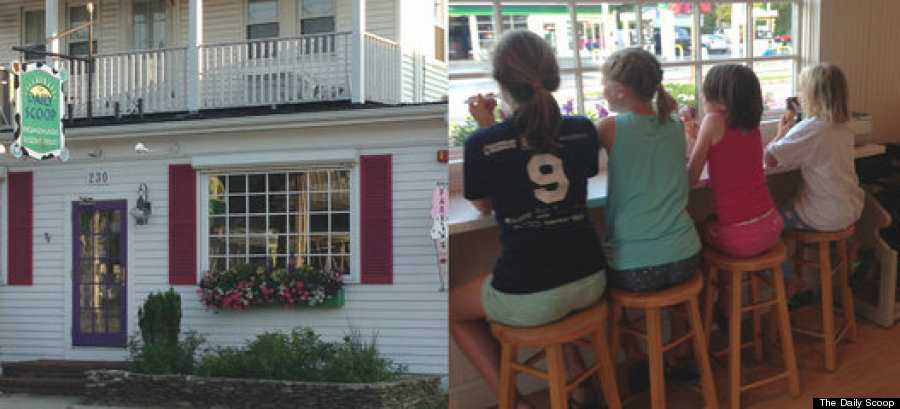
daily scoop
Deb and Bob Saunders are owners The Daily Scoop, which has two locations in Rhode Island — one in Bristol and one in Barrington. They both grew up in Barrington, which is where the original store and manufacturing facility opened.

Rich Farm Ice Cream (Connecticut)
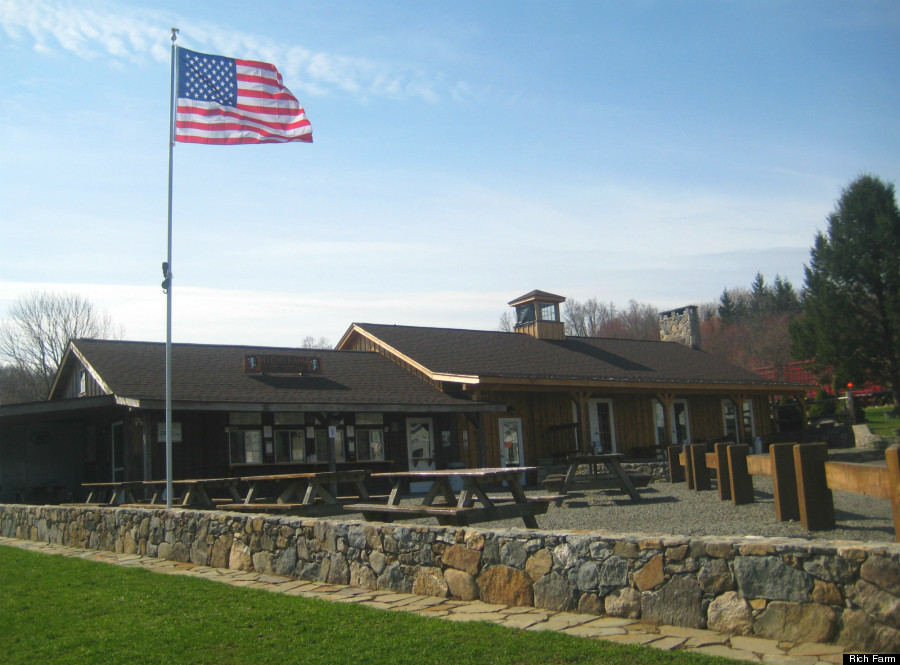
rich farm
Rich Farm, located in Oxford, CT, has been open since 1994. Dave and Dawn Rich run the ice cream shop, which is situated on Ajello’s Farm. Dave’s great great grandfather started the dairy five generations ago on Great Hill in Seymore, CT. Dave and his children opened Rich Farm Ice Cream on the dairy farm, and today the shop churns out up to 30 fresh flavors ice cream every day.

Lago’s Ice Cream (New Hampshire)
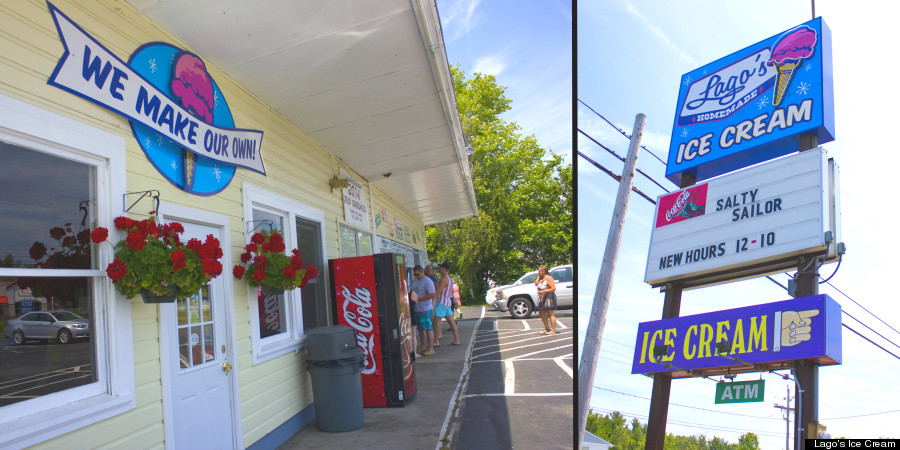
lagos
Andrea and Stephen Grenier own and run New Hampshire-based Lago’s Ice Cream. Andrea’s parents opened the store in 1981, and Andrea and Stephen’s children — Michael, 22, and Erica, 25 — also pitch in. Stephen attended Penn State Ice Cream School in 1986, but told The Huffington Post that he learned most of what he knows from his wife’s grandfather, Arnold Wade, or “Gramps.”

The Bucket At Gulf Hill (Massachusetts)
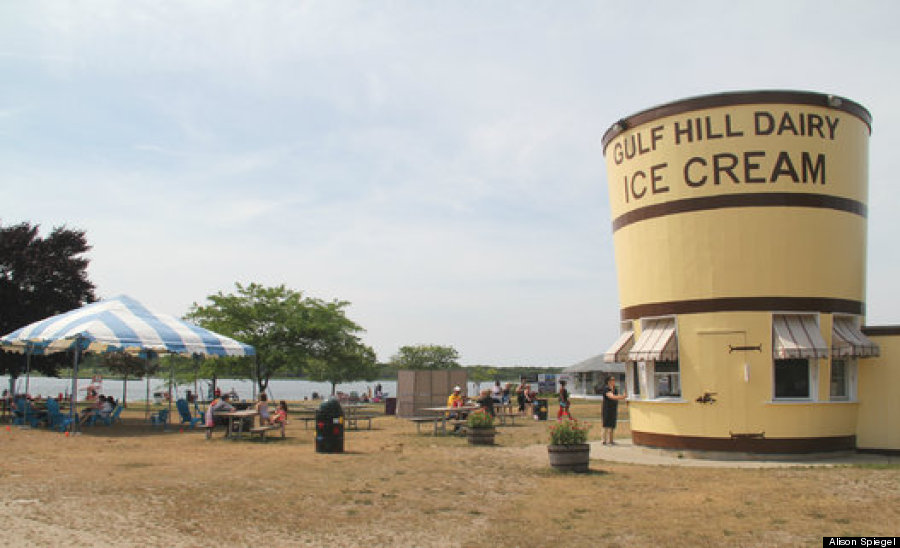
the bucket2
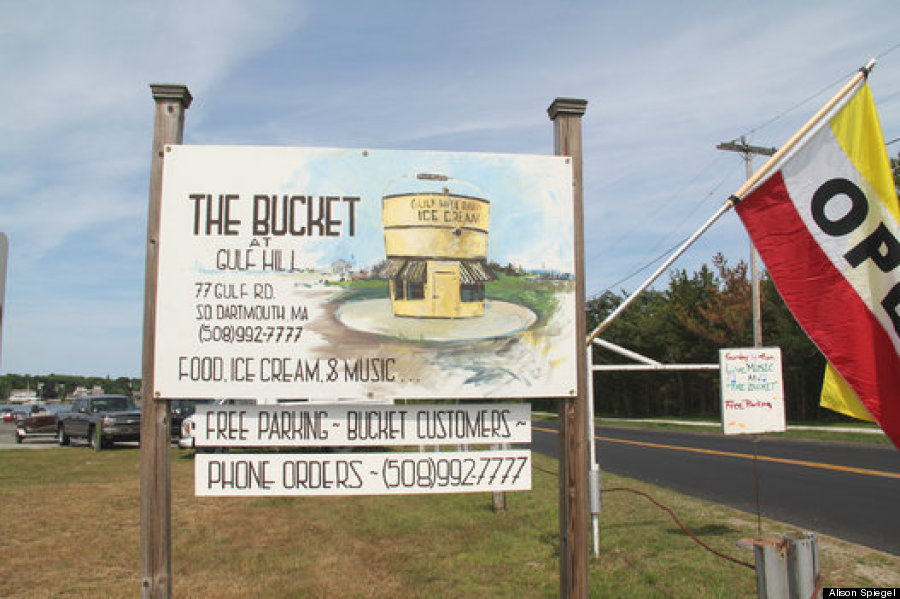
The Bucket At Gulf Hill is an ice cream stand on the shore just outside of Padanaram Village, a harbor-side town in South Dartmouth, MA. It was built in 1929 at Gulf Hill Dairy, and was moved to its current location in Apponagansett Park on Padanaram Harbor in 2003.

the bucket1
The Bucket is open seasonally and among other things, it sells ice cream, burgers and lobster rolls. In addition to the food, Bucket-goers enjoy music in the park and the beach that is just steps away.

Buttonwood Farm Ice Cream (Connecticut)
buttonwood farms
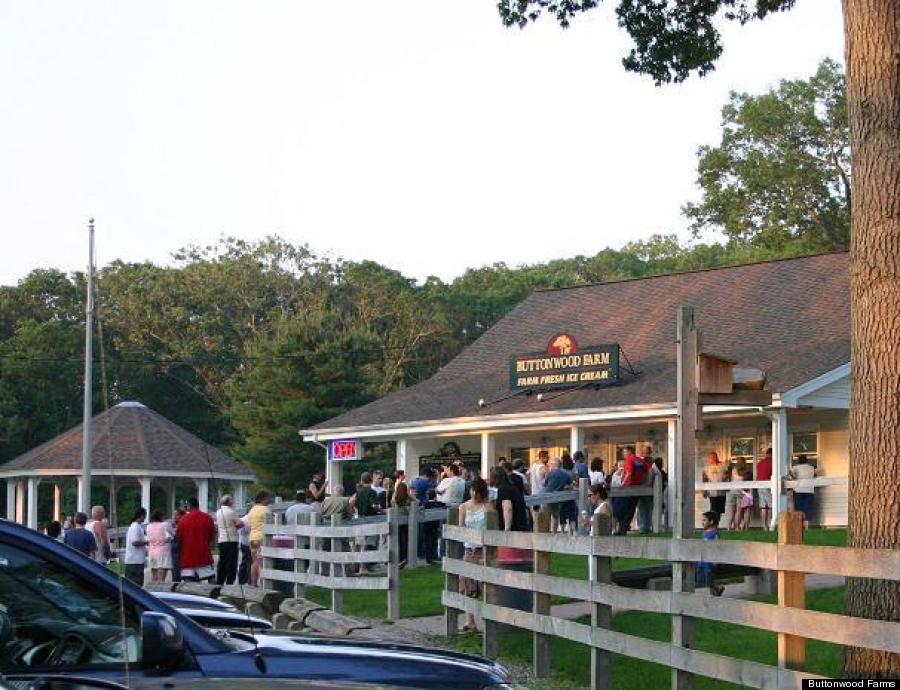
Buttonwood Farm opened in 1975 as a cattle farm, merchandising cattle and feed, as well as a dairy for selling milk wholesale. In October, 1997, the family built the ice cream stand, which officially opened in May, 1998. Buttonwood Farm Ice Cream makes its own ice cream and waffle cones fresh each day.

Brown’s Old Fashioned Ice Cream
browns ice cream
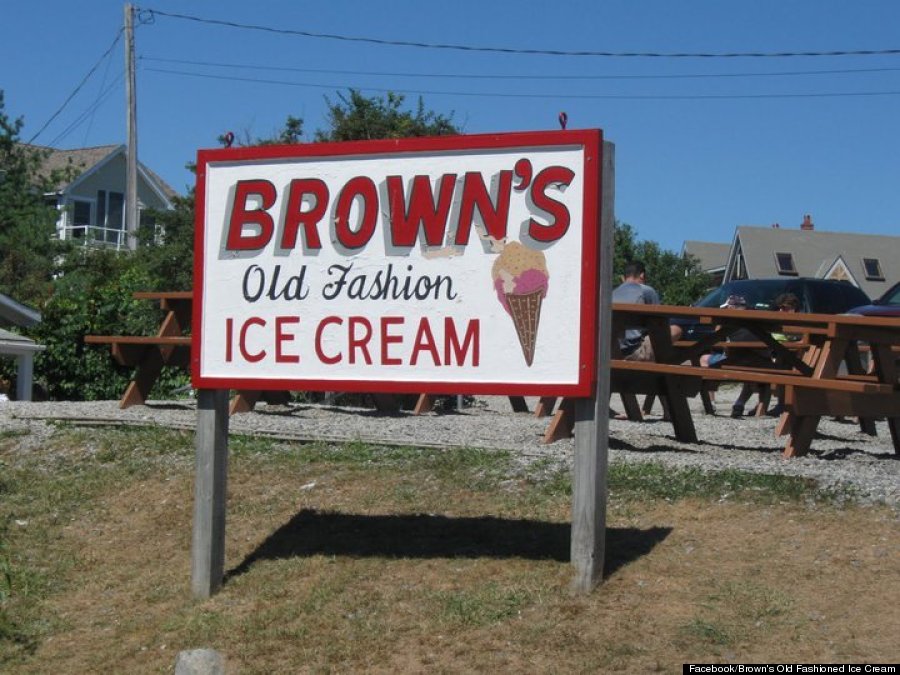
Brown’s Old Fashioned Ice Cream is located in York, Maine, not far from the famous Nubble Lighthouse. It’s something of an institution in the town and well-known throughout the state.

The Caboose Ice Cream Stand
the caboose
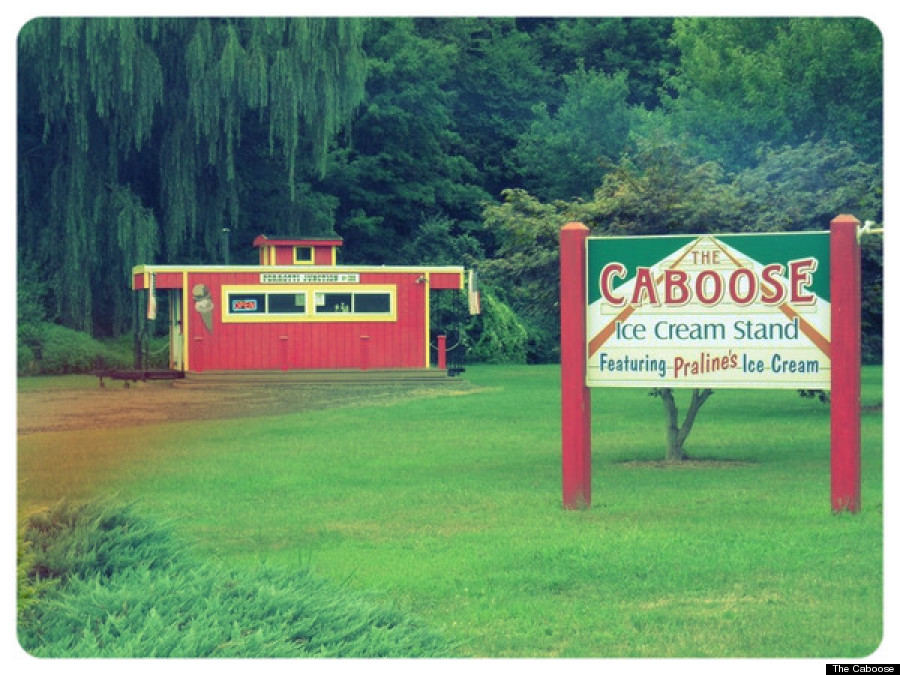
Perrotti’s Country Barn — which sells unique gifts like jewelry, home decor, candles and cards — opened in December 1999. In the spring of 2004, the Caboose Ice Cream Stand opened. It sits right next door to Perrotti’s Country Barn, on the same property. The Caboose sells more than 25 flavors of Praline’s Ice Cream, which is made locally in Wallingford, CT. Perrotti’s Country Barn and the Caboose have been completely family run since the beginning.

Which of your favorite New England ice cream stands didn’t make the list? Let us know your favorites below.

Want to read more from HuffPost Taste? Follow us on Twitter, Facebook, Pinterest and Tumblr.

No Image

Maine’s Shrimp Fishery May Face New Restrictions

July 6, 2014 0

PORTLAND, Maine (AP) — Federal regulators may limit the number of fishermen allowed to catch northern shrimp in the Gulf of Maine once the depleted fishery reopens.

The Atlantic States Marine Fisheries Commission closed the shrimp season for 2014 for the first time in more than 30 years because shrimp populations dipped to their lowest recorded levels. The commission will decide this fall if there will be a 2015 season. The commission’s northern shrimp section is now also considering restrictions that could limit the number of licenses to fish for shrimp or the number of vessels allowed in the fishery. The restrictions are in development and will likely be the subject of public hearings this year, regulators said.

The fishery’s estimated biomass plunged from more than 7,000 metric tons in 2011 to about 500 metric tons in 2013, said Marin Hawk, management plan coordinator for the commission.

“We’re investigating the number of vessels and the number of licenses,” Hawk said. “Indicators show the fishery is not at the levels that they would like it to see.”

The number of vessels in the fishery has fluctuated since 2000, with a low of 144 in 2006 and a high of 342 in 2011. Maine issued an average of 463 licenses per year from 2001 to 2011. The shrimp section also sets a total allowable catch limit every year.

Fishermen from Maine, New Hampshire and Massachusetts fish for the shrimp. Maine dominates the fishery and caught nearly 5 million pounds of the shrimp in 2012. The catch plummeted to about 560,000 pounds in 2013, the last year the fishery was open.

Tim Simmons, president of the Maine Shrimp Trappers Association, said the move to limit participation in the fishery is unpopular with many fishermen. Many of the people who fish for shrimp are lobstermen who rely on shrimp fishing to make money during the winter months, he said. Timmons said a quota system is a better solution.

“We count on that fishery for our livelihoods,” Simmons said. “We definitely should be having some sort of season in this upcoming year.”

Northern shrimp are small, pinkish shrimp — tinier than the warm-water shrimp that make up much the U.S. shrimp harvest — and prized for their sweet, tender meat.

The three-state fishery exceeded $5 million in value as recently as 2012, and Maine’s fishery alone exceeded nearly $10 million twice in the mid-1990s. They are normally fished and available to consumers in the winter but have been largely unavailable since the shutdown.

New restrictions on the fishery would need shrimp section approval after public hearings.

No Image

10 States That Drink The Most Beer

July 4, 2014 0

24/7 Wall St.: In recent years, Americans have increasingly moved away from beer consumption in favor of wines and spirits. U.S. beer consumption fell slightly from 28.3 gallons per drinking-aged adult in 2012 to 27.6 gallons last year.

Despite declining across the United States overall, beer consumption remains quite high in some states. According to a recent study from Beer Marketer’s Insights, a brewing industry trade publisher, North Dakota residents consumed 43.3 gallons of beer per drinking-age adult in 2013, the most of any state. This was more than double the 19.6 gallons per legal age adult consumed in Utah, which drank the least beer. Based on figures from Beer Marketer’s Insights, these are the states that drink the most beer.

Click here to see the States That Drink the Most Beer

Between 2002 and 2012, the share of Americans’ total alcohol intake coming from beer has declined. The average drinking age adult drank the equivalent of 1.39 gallons of pure ethanol alcohol from beer in 2002, with a total intake of 2.39 gallons from all drinks consumed. In 2012, Americans pure alcohol intake was 2.46 gallons per person. Americans’ alcohol intake from wine and spirits rose by 15.2% and 20.9%, respectively, between 2002 and 2012. Meanwhile, intake from beer dropped by 8.6%.

While some of the states that drink the most beer generally followed this national trend, other states did not. Between 2002 and 2012, alcohol intake from beer consumption declined by 17.4% in Nevada, one of the top beer drinking states. In that time, alcohol intake from wine rose by more than 30%. On the other hand, alcohol intake from beer rose by more than 10% in both Vermont and Maine, also among the top beer drinking states.

Consuming excessive amounts of alcohol is associated with a range of health problems. One in 10 deaths among working age adults in the United States is due to excessive drinking, according to figures recently released by the Centers for Disease Control and Prevention (CDC).

According to the study, “Excessive alcohol use is responsible for 2.5 million years of potential life lost annually, or an average of about 30 years of potential life lost for each death.” Leading the nation in beer consumption, however, did not necessarily increase years lost per legal-age adult. Only three of the top beer drinking states exceeded the national average for years of potential life lost per 100,000 residents between 2006 and 2010.

According to Mandy Stahre, a co-author on the CDC’s study and an epidemiologist with the Washington State Department of Health, health outcomes such as alcohol attributable death rates are influenced by a number of factors, not only drinking patterns. “The number and the enforcement of alcohol control policies … sociodemographics, religious affiliation, race and ethnicity” all can play a role in determining the health consequences of drinking.

In an email to 24/7 Wall St., Eric Shepard, vice president and executive editor at Beer Marketer’s Insights, highlighted a study from the U.K.-based Institute of Economic Affairs, a free market think tank. The study explores the relationship between problematic drinking and consumption levels.

Policy makers often believe that high per capita consumption leads to excessive drinking, which includes heavy and binge drinking. However, the study’s authors contend that “per capita alcohol consumption largely depends on the amount of heavy drinking in the population, not vice versa.” Stahre added the she, too, was aware of studies that showed “a good proportion of the alcohol that was consumed was being consumed in a manner [associated with] binge drinking.”

The states with the highest beer consumption rates also had high rates of heavy drinking — defined as more than two drinks per day for men and more than one drink per day for women. In Montana and Wisconsin, 8.5% of adults were heavy drinkers as of 2012, tied for the most in the United States and well above the national rate of 6.1%. Additionally, seven of the states that drink the most beer had among the 10 highest rates of binge drinking — defined by the CDC for women as consuming four or more drinks, and five or more drinks in the case of men, during a single sitting.

Interestingly, while excessive alcohol use is hardly a healthy behavior, many of the states with the highest beer consumption rates were also likely to practice a range of healthy behaviors such as exercising regularly and eating well. People in Maine, New Hampshire, South Dakota and Vermont, for example, were all among the most likely Americans to eat healthy all day last year. Residents of Nebraska, New Hampshire, North Dakota and Vermont were among the most likely to exercise regularly.

Stahre noted, however, that people are often better at keeping track of other behaviors than they are about drinking. “Because if you aren’t paying the bill or not paying attention to the number of drinks you have, you could really be underestimating what your consumption is.”

To identify the states with the highest beer consumption rates, 24/7 Wall St. reviewed Beer Marketer’s Insights’ recent report on alcohol consumption. Drinking habits were measured in gallons shipped to distributors annually per 100,000 drinking-age adults. Adult heavy and binge drinking statistics are from the CDC’s Behavioral Risk Factor Surveillance System and are for 2012. We also utilized figures from a recent CDC study, titled “Contribution of Excessive Alcohol Consumption to Deaths and Years of Potential Life Lost in the United States.” This study examined data from 2006 through 2010 for Americans of all ages. We also reviewed healthy behaviors and health outcomes from Gallup’s 2013 HealthWays Well-Being Index. Economic data came from the U.S. Census Bureau’s 2012 American Community Survey. Brewery totals are from the Beer Institute’s 2013 Brewer’s Almanac and are for 2012. Tax data are from the Federation of Tax Administrators and are current as of January 2014.

These are the states that drink the most beer.