No Image

#NapaQuake: How You Can Help Keep #NapaStrong

August 30, 2014 0

Bottle shock.  Crushed.  Shaken, not stirred.  Whatever word you choose to describe it, the 6.0 magnitude earthquake that rocked Napa Valley early Sunday morning has left behind more than spilled wine.  More than 100 homes and buildings red-tagged.  The facade of the beautiful Vintners Collective building gone.  Homes shaken off foundations, cracks in walls, chimneys toppled.  Countless glasses, plates and other personal possessions shattered.  Gallons and gallons of wine lost.  

All this happening as harvest is underway. Winemakers who lost tanks and barrels are scrambling to find ones they can borrow or rent so they can press, ferment and store the new wines coming in as we speak.

Some producers lost freshly made wines from the current vintage, but they also lost library wines — collections of wine going back years, if not decades.  Wineries also lost wine in barrel that hadn’t made it to bottle yet, as barrels toppled from stacks five and six high.  As if we need to be reminded, these wines can never be replaced.

Winery Shake Up

Monique Soltani of WineOh! TV headed up to Napa with her camera as soon as she could to document the aftermath and check in with vintners most impacted by the quake.  At Bouchaine Vineyards, they lost at least 8 barrels of wine.  A barrel holds 25 cases worth of wine, or 300 bottles.  That’s roughly 2,400 bottles.  Keep in mind full wine barrels weigh about 600 pounds.  How lucky that the earthquake struck in the middle of the night when no one was in the winery.

The situation is all to familiar for winemakers at Matthiasson, Cornerstone Cellars, The Hess Collection, Sebastiani, Lagier-Meredith, who found toppled jumbled wine barrels, damaged tanks and wineries flooded with wine.

Of those affected, many are small operations, mom and pop, family owned wineries, eateries and boutiques.

Ceja Vineyards is one of those.  Their tasting room is on First Street in downtown Napa.  They lost 12 cases of wine and every Riedel wine glass.  The very heavy statue of Bacchus toppled over and broke its head and neck (it weighs about a ton).  At their property in Carneros, a big Buddha statue was knocked over.  Amelia Ceja and her family are not deterred.  They’ve been harvesting all week as they deal with the clean up.  Amelia says, “We are ready to receive visitors and locals alike with open arms and our legendary Ceja hospitality!”

Hailey Trefethen and her mother arrived at their family winery shortly after the earthquake occured.  “We noticed right away that something was not right,” she says.  They found the base of the 1886 historic landmark winery building which houses the Trefethen Famiy Vineyards tasting room in tact, but “as you go up from the base to the second floor the building shifted four inches,” Hailey says.  “The top two floors are still in line.”
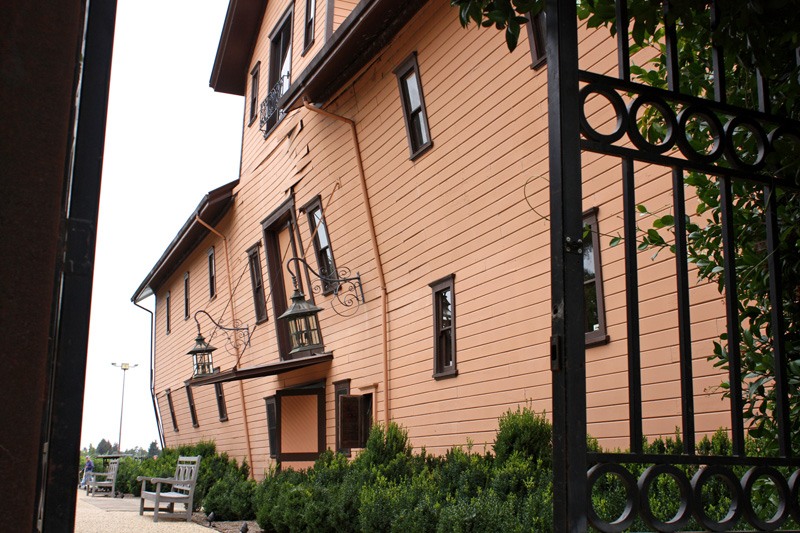
Courtesy Trefethen Family Vineyards

Courtesy Trefethen Family Vineyards

The Trefethen building is one of four wineries designed by Hamden McIntyre, who also created the distinctive stone winery buildings at Far Niente Winery, Inglenook and the Culinary Institute of America (formerly Christian Brothers winery).  It survived both the 1906 and 1989 earthquakes, and hopefully this one.

The historic building is red-tagged and no one hss been able to enter it to survey the damage.

“It’s safety first,” Hailey says.  “We have a construction crew and structural engineers shoring up the building to make it stable so the engineers can go in and assess damage.”  Right now they are setting iron into 12 feet deep concrete footings.  “They are optimistic which makes us optimistic the building can be restored.”

Courtesy Trefethen Family Vineyards

Courtesy Trefethen Family Vineyards

The other winery buildings are fine and while some tanks pulled away from walls and were dented, no wine was lost.  Trefethen started harvest on Friday.  “Things are getting back to normal,” says Hailey.  “Through all of this our team has been incredible and I am forever grateful.”
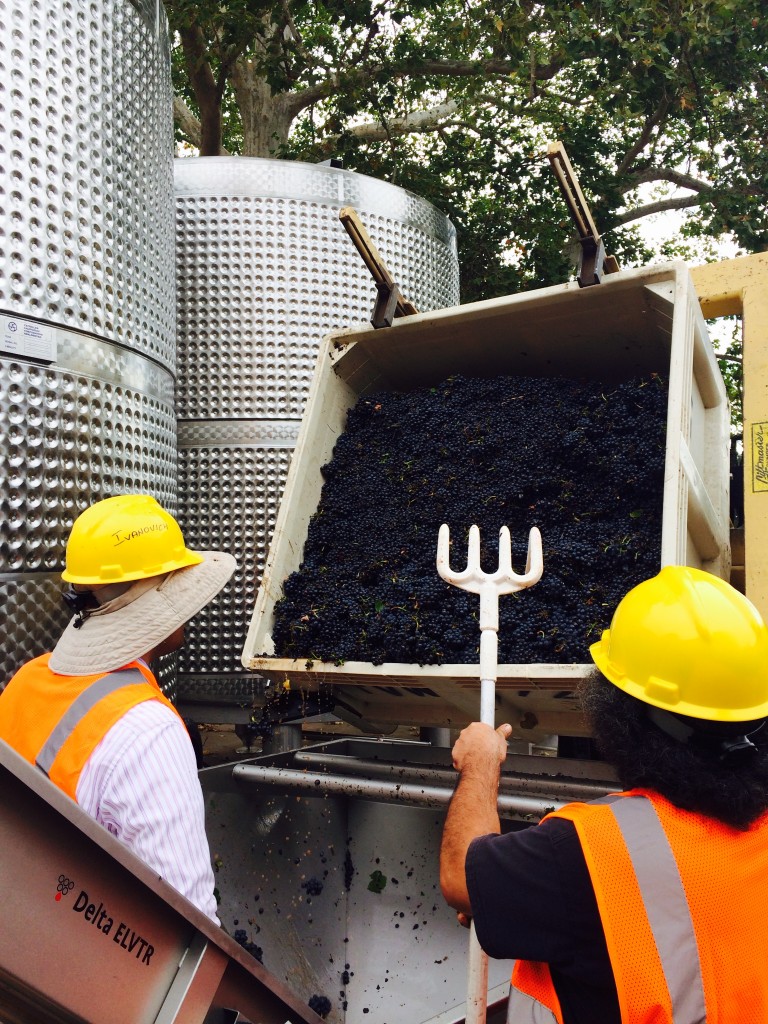
Courtesy Trefethen Family Vineyards

Folks in Napa and wine country are a resilient bunch, ready to lend a hand even when their homes or businesses have been hit hard.  And, they’re not about to let an earthquake get in the way of what’s shaping up to be another spectacular vintage.  They’ve cleaned up, and opened doors to their wineries, restaurants, hotels and shops as quickly as they can.

How You Can Help

What they need is our help, because Napa is open for business.  Now more than ever is the time to drink Napa wine, buy Napa products, dine in Napa restaurants, visit the wine country.  Most of these wineries don’t have earthquake insurance.  It’s just so expensive, and really, who thought Napa was on a major fault? 

Elaine Brown writes the well regarded Hawk WakaWaka Wine Reviews blog.  She also checked in with winemakers and surveyed the damage downtown.  Here’s her post of what she found.

In addition to all that, Elaine stopped by Oxbow Cheese & Wine Merchant, a shop at the Oxbow Market that carries small production Napa wines.  They’re having an earthquake sale, for wines “kissed by” the quake with damaged labels but not broken.  Like Elaine, I encourage you to go buy wine, especially from wineries who were impacted the most.

 “No one has earthquake insurance because it doesn’t make economic sense,” Elaine says.  “So small businesses are having to just swallow the losses. Buying from Napa small business online, or any Napa label is helpful.”

She also stopped by The Vintners Collective, where the facade of this beautiful old building came completely off in the shaking.  This collective tasting room is home to very small production wineries who don’t have tasting rooms of their own.  So check out their website and find those producers to buy wine from and help them all get through this.

Other small wineries that you may not have heard about have also been affected, including Lightening Wines, who had equipment damaged and lost part of their 2013 vintage.

Winemaker Joe Wagner of Meiomi rushed to his St. Helena winemaking facility Sunday morning to find the power out and two severely damaged tanks leaking wine that was ready to be bottled.  Each tank holds 25,000 gallons.  “The weld seam at the ankle at base had split open, up to a one by three inch hole,” he says.  “Wine was spewing out of those.”  Four other tanks were also leaking.

Thinking quickly Joe found hoses to transfer the remaining wine in tanks to empty tanks.  He called in his crew, got extra tanker trucks to the wine.  He used gas-powered ag pumps to move the wine and save “somewhere around 20 to 30,000 gallons of wine that would otherwise have gone down the drain.”  He credits quick response from his crew, the arrival of a generator and welder to repair the tanks.  “At the end of the day we lost about 28,000 gallons of Meiomi 2013 Chardonnay.”  That’s about 15-20% of his production.  He also lost about 1,000 gallons of Napa Valley 2012 red and Oregon 2013 Pinot Noir.

Joe says the best way to support the community is to visit Napa and enjoy the wine, food and all the other things Napa has to offer.  “This is a small setback,” he says.

“The really big thing to drive home is that Napa is open and ready for business,” Elaine says.  “We do need help but for those that can visit, we need that most of all.”

Winemaker Bridget Raymond reports minimal damage to her wine label Courtesan Wines.  But she has friends and a client who weren’t as fortunate.  So she’s created a fund to help raise money for the community.

Most importantly, says Bridget, “Napa is open for business.”  When you donate to the Napa Earthquake Community Fund, you can choose from various “rewards” for wine tasting experiences throughout the valley.  100% of the money raised goes directly to affected by the earthquake.  “I set up this page,” Bridget says, “so I know that 100% of the funds will go to those who need it and might otherwise be overlooked.”

The first $1,000 raised will go to the family of Nicholas Dillion, the 13 year old boy injured by bricks falling from the fireplace during the quake, to help with medical costs.  The rest of the money raised will go to local charities that help with food and childcare of volunteers,” Bridget says.  “People such as Nola Rawlins who lost her home in a fire, and local businesses or small winemakers hit the hardest who have no insurance..”

You can help out by donating to the Napa Earthquake Community Fund.  

The Napa Valley Vintners has created a community disaster fund, donating $10 million to the Napa Valley Community Foundation, and they encourage those who want to help to contribute.  You can donate to Neighbors Helping Neighbors.  Clinic Ole is offering help to low income and vineyard workers.  Shelter for people who lost or are being temporarily displaced from their homes is being provided by the Red Cross’s Napa County chapter.

Buy and Open a Bottle (or Two) of Napa Valley Wine

At Back Room Wines in downtown Napa owner Daniel Dawson specializes in small production, unique wines.  He lost some bottles — about 50 according to the shop’s Facebook page – but nothing major in the scheme of things.  Now is the time to stop by, browse his well-edited selections (also available online), taste a few wines you may not have heard of, and support this local business and wineries.

The one thing I hear over and over from vintners is that one good (and fun and easy) way to help out is to buy and open a bottle or two of Napa Valley wine this weekend.  My friend and publicist Monty Sander  reminds us on his Facebook of the “open that bottle night” that the wine writers John Brecher and Dorothy Gaiter promoted every year in their Wall Street Journal column.  Well make this Labor Day holiday weekend “open that bottle of Napa wine night” — especially a bottle from one of the wineries hardest hit by the earthquake.

No Image

Bacon Is So Damn Delicious, Even Vegetarians Can’t Resist It

August 30, 2014 0

Bacon is one of America’s sweethearts. It’s a darling, succulent food that pairs flawlessly with breakfast and instantaneously improves any bloody Mary. Plus, bacon certainly knows how to complement a burger. It also has standalone power: Bacon tastes just as incredible when simply plucked from the frying pan, dripping its own fatty bacon juices.

Another great thing about bacon? You can wrap it around just about anything. Like doughnuts. And hot dogs. Seriously. In honor of International Bacon Day (Aug. 30) we encourage you to wrap bacon around any food you can get your hands on. Here’s a little inspiration below.

(See more bacon-wrapped recipes here.)

And still, the impressiveness of bacon spans beyond its ability to be wrapped around other foods. Bacon can change people.

Bacon’s flavor is so irresistible that even those who identify as vegetarians will stray from their restrictions to have a taste. According to data specialists at EAT Club, a California-based lunch delivery service, 7 percent of claimed vegetarians and vegans have deviated for an entrée containing bacon. Bacon might consider running for president one day. Learn a little more about bacon’s political power in the infographic below and then please (please!) go enjoy some for your next meal.


Courtesy of EAT Club

Want to read more from HuffPost Taste? Follow us on Twitter, Facebook, Pinterest and Tumblr.

Follow HuffPost’s board Bacon — It’s All About The Bacon on Pinterest.

No Image

Kids Try Vegemite For The First Time, React Just As You’d Expect

August 29, 2014 0

It isn’t chocolate; it isn’t pudding; and it isn’t “Nutella that’s weird.”

It’s Vegemite, a classic Australian spread made from spent brewer’s yeast, and these kids are tasting it for the first time on video.

“Cookies!” screams one tiny tot, who coul…

No Image

Tuesday! Let’s Chat About Dive Bars

August 29, 2014 0

What is a dive bar? Why are dive bars? All your dive-bar questions will be answered.

No Image

Where to Drink While You’re Waiting to Eat at Rose’s Luxury

August 29, 2014 0

Option No. 1: Bucket of Coronas.

No Image

Food Bank Gardeners Provide Fresh Food To Those In Need: Here’s How You Can Help

August 29, 2014 0

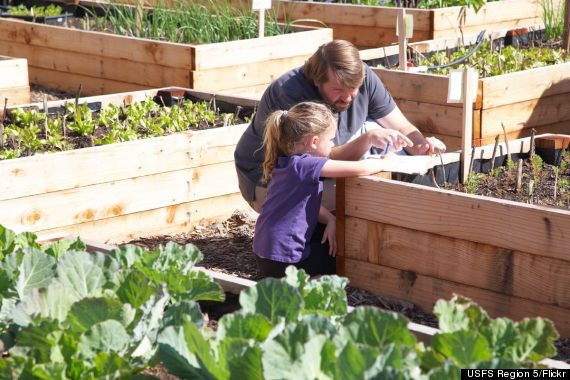
peoples garden

A father shows his daughter sprouts at the Vallejo People’s Garden in California. (Photo: USFS Region 5/Flickr)

This story originally appeared on Mother Nature Network.

It hurts when your stomach is empty. Across the land of plenty that is the United States, 49 million people in 17.6 million households feel that pain.

The almost 18 million homes with no food, an insufficient amount of food or a lack of healthful food represent 14.5 percent of all U.S. households, according to U.S. Department of Agriculture statistics for 2012. The USDA has a name for this aspect of hunger: food insecurity.

Food insecurity means that a household is uncertain of having, or is not able to acquire, enough food to meet the needs of all of its members because of insufficient money or other resources. These households are present in every state and most communities across the U.S., especially in rural areas.

It doesn’t have to be this way, says USDA spokesperson Wendy Wasserman.

“There are at least three resources that gardening enthusiasts concerned with eliminating food insecurity should know about,” Wasserman says.

These resources connect everyday gardeners and volunteers and the food they grow or collect with food banks and pantries. The USDA supports two of these resources and partners with the third.

One resource is the USDA People’s Garden, a collaborative effort of more than 700 local and national organizations that establish community and school gardens across the country and donate food to the needy.

The second is the USDA Guide to Gleaning, an online toolkit that helps people collect excess fresh foods from farms, gardens, farmers markets, grocery stores, restaurants, state/county fairs or other sources and provide it to those in need.

A third resource, Wasserman said, is AmpleHarvest.org, A USDA partner nonprofit that helps the 42 million Americans who grow fruit, vegetables, herbs and nuts in a home garden find local food pantries where they can donate their harvests.

If you would like to help alleviate food insecurity in America, here is a guide to creating a People’s Garden with like-minded neighbors, tips on collecting excess food, and an online search function for locating food banks or food pantries in your area that accept donated food and distribute it to those in need.

headquarters peoples garden

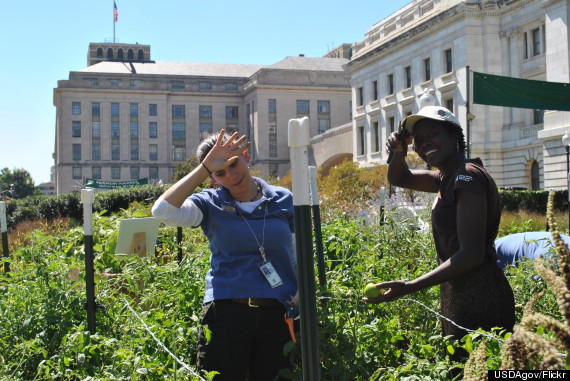
Volunteers harvest from the Headquarters People’s Garden, in Washington, D.C., every Tuesday. (Photo: USDA/Flickr)

People’s Garden

The USDA launched the People’s Garden initiative in 2009. The name honors President Abraham Lincoln’s description of the USDA, which he created in 1862, as the “People’s Department.”

The original goal of the 2009 initiative was to challenge USDA employees to create gardens at agency facilities. Since then, local and national groups have embraced this concept and established community and school gardens in all 50 states, three U.S. territories and eight foreign countries.

People’s Gardens exist in every shape and size imaginable, but the USDA requires that all of them share three common characteristics: They must benefit the community by creating a recreational space or providing harvest for a local food bank or shelter, they must be a collaborative partnership of local people or groups, and they must incorporate sustainable practices.

Although People’s Gardens are most often established as vegetable gardens, they can also be created for beautification, as wildlife habitats or for other purposes as long as they meet the three criteria noted above. The USDA invites workers at all People’s Gardens that produce food to donate their harvests to those in need, but makes this an official requirement if the garden is on property owned or leased by the USDA.

Existing garden community or school gardens can gain the People’s Garden designation as long as they meet the USDA’s requirements. Home gardens are not eligible to become a People’s Garden.

As of May, volunteers have contributed 211,884 hours to 2,014 People’s Gardens across the country and beyond. Their efforts have produced at least 3.8 million pounds of produce.

If you would like to volunteer at a People’s Garden, you can find out if there is one in your community by visiting the People’s Garden website and entering your city and state.

For questions about People’s Gardens, contact Wasserman at [email protected] or 202 260 8023.

gleaning cabbage

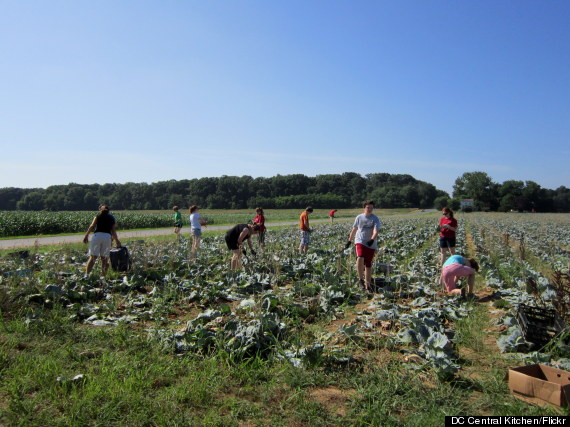
Gleaners make a second pass through a cabbage field in Maryland. (Photo: DC Central Kitchen/Flickr)

USDA Guide to Gleaning

Gleaning in this case refers to the simple act of collecting and donating excess food. If this is a practice that appeals to you, you won’t have any trouble finding food to collect. Each year, Americans throw away more than 100 billion pounds of food, according to the USDA, which based its calculations on a New York Times article, “One Country’s Table Scraps, Another Country’s Meal.”

Places to collect excess food include farmers markets, nearby restaurants, supermarkets, neighbor’s gardens, community gardens, area farmers, state and county fairs and any other food sellers or distributors. Incentives are that donations are tax exempt, the Bill Emerson Good Samaritan Act removes all liability for food donations if donors take basic precautions to ensure the safety of food, and participating in food gleaning to serve those in need is an excellent way to promote a business.

The USDA has published an online toolkit to help you start a gleaning program in your community. The toolkit explains gleaning and its benefits in detail and offers a guideline on how to set up a program.

community center

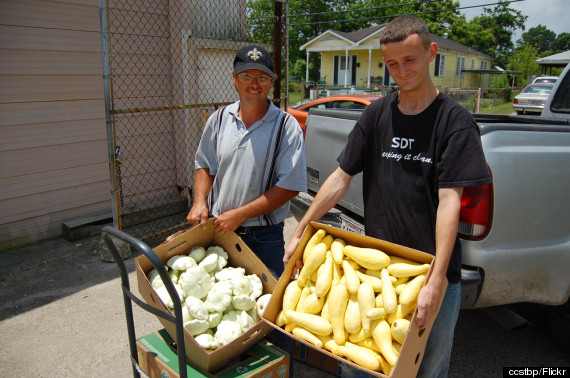
Farmers donate some their crops to a food pantry in Louisiana. (Photo: Billy Brown/Flickr)

AmpleHarvest.org

Now that you’ve grown or collected food to donate, how do you find a food bank or pantry to accept it? That’s where AmpleHarvest.org comes in.

Ample Harvest is a 501(c)3 charitable organization that helps people find food pantries where they can donate surplus food and provides an online site where food pantries can register to help donors can find them. A list of food pantries is available online. You can also use AmpleHarvest.org’s iPhone or Android apps to find a local food pantry when you are shopping. Food pantries can register on the website.

To help publicize its efforts, in addition to online search functions, AmpleHarvest.org offers fliers, newsletter articles and a media information page on its website. The site includes an FAQ that answers questions such as the difference between a food bank (large operations that deliver food to food pantries) and food pantries (walk-in facilities where families in need can go to get food).

No accurate statistics are available on how many food pantries exist in the United States. According to some estimates, there may be more than 40,000. Whatever the actual number, it is large — large enough for there to be one near you.

food bank visit nass

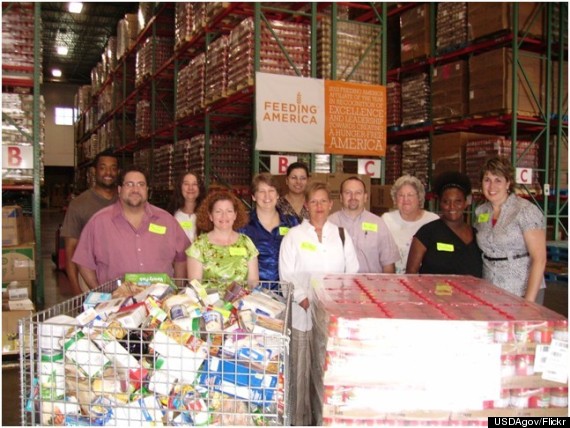
USDA employees in Tennessee visit their local Second Harvest Food Bank. (Photo: USDA/Flickr)

Other resources

There are other resources available to individuals and farmers who want to help alleviate hunger in America.

Feeding America, the nation’s leading domestic hunger-relief charity, seeks to feed America’s hungry through a nationwide network of farmers and member food banks. A program called Invest an Acre encourages farmers across the country to donate a portion of their harvests to help fight hunger in their own communities. Also, 18 Feeding America member food banks have working farms or large community gardens that vary in size from half an acre to more than 100 acres and grow a wide range of produce depending on the community need.

In addition, Feeding America has a long-standing partnership with Harvest for All to use the bounty produced on the nation’s farms and ranches. Through this nationwide program, the American Farm Bureau’s Young Farmers and Ranchers donate food, funds and volunteer hours to help create a hunger-free America.

Plant a Row for the Hungry is a campaign of the Garden Writers Association and the GWA Foundation. In this public service program, the GWA asks member writers and communicators to encourage their readers, viewers and listeners to plant an extra row of produce each year and donate their surplus to local food pantries, emergency kitchens and service organizations.

Separately, small farmers who may be averse to joining organizations can get in on the act by contacting food banks in their area or their local community-supported agricultural network about where and how to donate fruits, vegetables and herbs, or meats and poultry products for the hungry.